Never miss another blog post! Have our monthly insights delivered straight to your inbox through our new Substack, The Canadian Carbon Removal Roundup. Subscribe here.
Aviation is the textbook case of a hard-to-abate sector, and it has set itself a hard target to match: net-zero greenhouse gas emissions by 2050, even as passenger volumes are expected to double over the same period.
As this demand continues to rise, the sector will wrestle to overcome structural barriers: aircraft are built to last for decades and jet fuel is energy-dense for a reason. Unfortunately, there is no zero-emission replacement, like batteries or hydrogen, waiting in the wings at commercial scale. The system is also finely tuned: airlines operate on thin margins, airports are capacity-constrained, and aviation cannot swap out its energy backbone without rebuilding a global network.
Then there is scale. Jet fuel demand is measured in hundreds of billions of litres annually. Any decarbonization pathway has to work across long-haul and short-haul flights, across regions, and across fleets that turn over slowly.
Against that backdrop, a false choice has crept into the conversation: sustainable aviation fuel or carbon removal, as if they are competing technologies fighting over the same budget.
The real question is not substitution, but system design; a credible strategy will stack them. Net-zero aviation has always been a portfolio problem: SAF reduces emissions from fuel combustion, and carbon removal addresses what SAF cannot eliminate. Treating them as rivals for the same limited resources guarantees the plan falls short.
Why one fuel can’t carry the whole target
Betting the entire net-zero target on SAF carries risks that airlines, investors, and regulators should take seriously. No prudent investor builds a retirement portfolio around a single company, no matter how promising it looks. Net-zero strategies deserve the same discipline.
- Supply may not scale fast enough. Getting SAF to universal adoption by 2050 requires near-perfect sequencing of early demand, policy incentives, production capacity, and investor confidence. Much of that sits outside any single airline’s control. Carriers that have set ambitious climate targets are increasingly dependent on supply chains that do not yet fully exist.
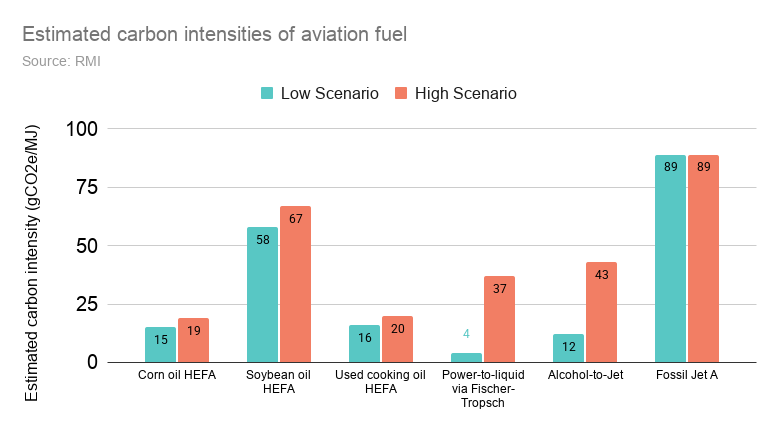
- Even at full adoption, emissions remain. Depending on the production pathway, SAF can reduce lifecycle emissions by 50 to 80 percent relative to conventional jet fuel due to introducing lifecycle emissions of its own through feedstock production, transportation, and processing. That leaves a substantial share of emissions without a direct solution.
- Overreliance is becoming a legal problem. Climate commitments now carry real financial consequences: one airline has already paid penalties for missing the greenhouse gas reduction targets embedded in its sustainability-linked bond. Others have walked back net-zero commitments while also facing class action litigation. A strategy with a single point of failure is a strategy that invites exactly these outcomes.
Carbon removal was always in the math
The clearest evidence that this is a stacked strategy, not a contest, comes from aviation’s own planning documents.
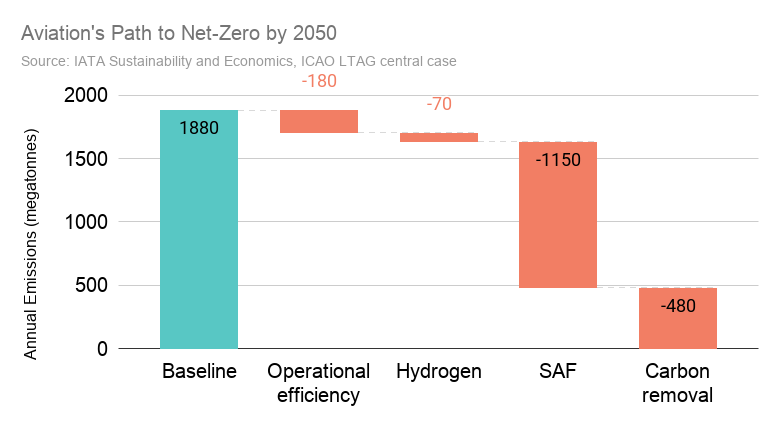
The International Civil Aviation Organization’s central net-zero scenario relies on both technologies. SAF reaches roughly 90 percent of aviation fuel demand while carbon removal scales to approximately 480 million tonnes annually. Together, SAF and carbon removal account for more than 85 percent of emissions relative to a 2018 technology baseline.
Even after assuming extraordinary SAF growth, the model still requires a large, permanent carbon removal market.
Carbon removal is not a fallback. It is embedded in the core math of net-zero aviation. And if SAF deployment falls short of projections, which remains a material risk, the required scale of carbon removal rises, not falls.
What stacking looks like in practice
Because carbon removal works indirectly, it can address residual emissions that SAF leaves behind, hedge against SAF supply shortfalls, and reduce reliance on the most expensive mitigation options. Instead of depending on every assumption in the SAF scale-up story proving correct, airlines gain a second pathway to maintain progress toward their climate commitments.
In practice, this makes net-zero targets more achievable, more resilient, and more credible. Neither technology has to be perfect, because neither is doing the job alone.
The leaders are already buying
Airbus, Boeing, SkiesFifty, British Airways, and All Nippon Airways have collectively committed to nearly one million tonnes of permanent carbon removal through offtake agreements worth hundreds of millions of dollars globally.
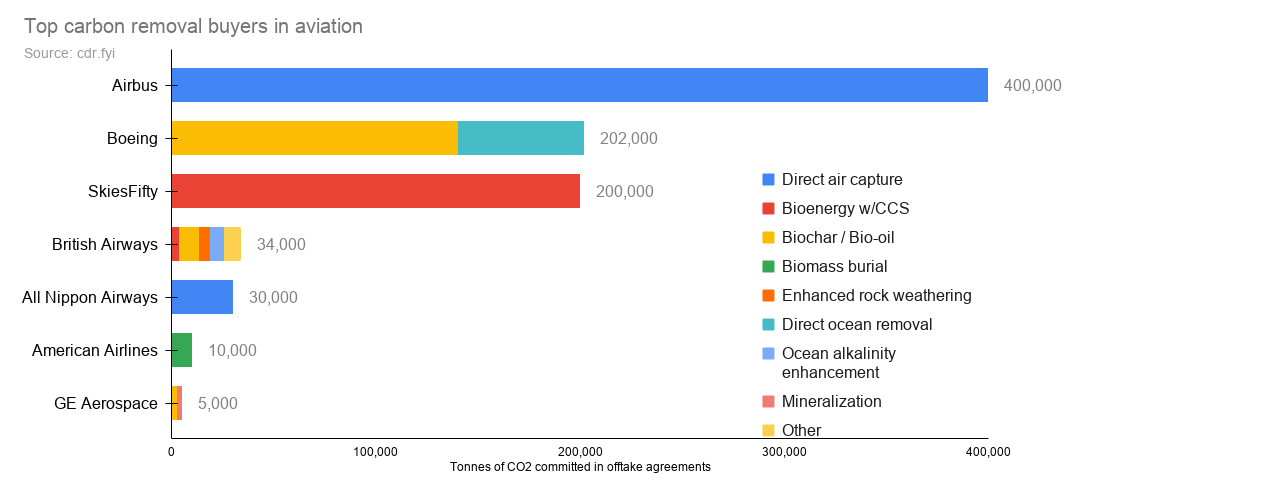
These organizations are not purchasing carbon removal because they doubt SAF. Rather, they’re purchasing it because they understand that SAF alone cannot eliminate every tonne of emissions or guarantee delivery against a 2050 target.
Notably, these purchases span a diverse range of carbon removal approaches, and with that are building experience in a market they expect to become increasingly important. Early movers gain advantages that latecomers will struggle to replicate. They secure future supply in a market where demand is expected to outpace availability, lock in favourable commercial terms while competition remains limited, and develop procurement expertise.
In a market this young, the learning curve itself can be an asset.
Two levers, pulled at once
Supporting carbon removal today is part of what makes aviation’s net-zero commitments achievable, alongside the buildout of sustainable aviation fuel.
Net-zero aviation was never going to come from a single technology, and it was never designed that way. SAF will do most of the heavy lifting on fuel emissions, but it won’t eliminate them entirely. Carbon removal fills the gaps SAF can’t reach and helps keep long-term targets within range when real-world deployment doesn’t match forecasts.
The airlines that stay on track will be the ones that build a plan with enough margin for reality, where SAF and carbon removal are developed in parallel, not treated as competing priorities.
The runway to 2050 is shorter than it looks. Best to take off with both engines.